AI integration studio

We build AI into the business you already run.

Not a pilot that dies in a slide deck. Working software inside your existing operation: reading your documents, answering your customers, catching the thing about to go wrong.

Free We build it · You run it free for 3 months · No contract · Cancel anytime

Based in Beirut and the United States. Working across Lebanon, the UAE, Saudi Arabia, and the Gulf

Systems shipped
07
Live in production
05
On the App Store
01

Most companies do not need a new AI product. They need the twenty things someone retypes every day to stop needing a person, and they need to trust the result. That is an engineering problem, not a strategy problem.

How we work

Map, pilot, production. In that order.

The failure mode of AI projects is a six-month build against a problem nobody measured. We invert it: prove the value on one narrow workflow first, cheaply.

  1. 01

    Map

    We look at how the work actually gets done and find where AI pays. Free, and you keep the findings whether or not you hire us.

  2. 02

    Pilot

    One narrow workflow, fixed scope, live in weeks. You see it working on your real data before committing further.

  3. 03

    Production

    Hardened, permissioned, monitored, and handed over. Your repository, your infrastructure, your accounts.

  4. 04

    Operate

    We stay on to tune it against real usage, or we train your team and step back. Your call.

Proof

Most agencies show you a deck. We show you software running.

07
Shipped
05
Live now
01
App Store

Including an AI assistant serving customers in Lebanese Arabic, and a takeoff system reading construction drawings inside a contractor’s existing workflow.

See the work

Selected work

What we’ve built.

01 Live

AI ordering assistant for a supermarket group

Supermarket group · Bekaa Valley, Lebanon

An Arabic-first ordering platform with an assistant that talks to customers in Lebanese dialect, plus an AI back office that catalogues the shelves.

What the AI does

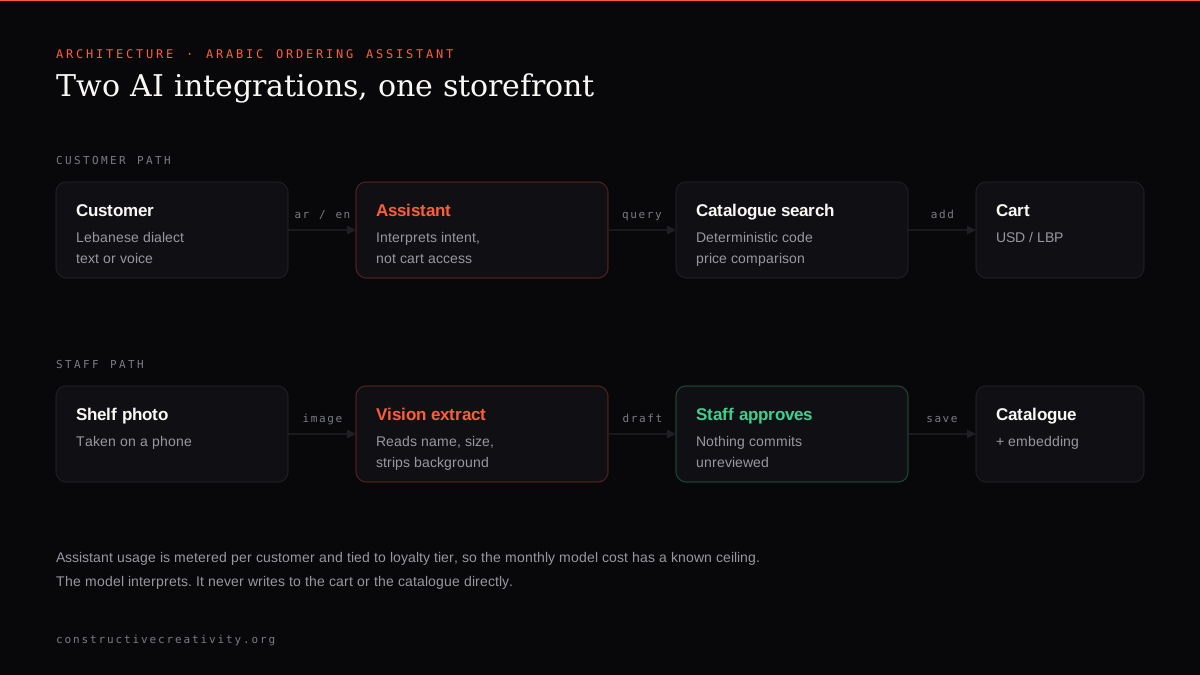
Two integrations. A customer-facing assistant that chats and takes voice in Lebanese Arabic. It answers "what’s the cheapest olive oil you have," then adds it to the cart directly. And an AI Product Studio for staff: photograph a shelf item, Claude vision reads it, the background is stripped, and a catalogue entry comes back pre-filled and searchable. Assistant usage is metered per customer with loyalty tiers, so the AI cost stays bounded.

  • Next.js 14
  • Supabase
  • Claude
  • next-intl (RTL)
  • PWA
Architecture: customer path through the Arabic assistant, and staff path through vision extraction
02 Shipped

AI takeoff for facade estimating

Rainscreen facade contractor · United States

Reads the architectural drawings, counts the panels, and prices the job, inside the estimating workflow the team already used.

What the AI does

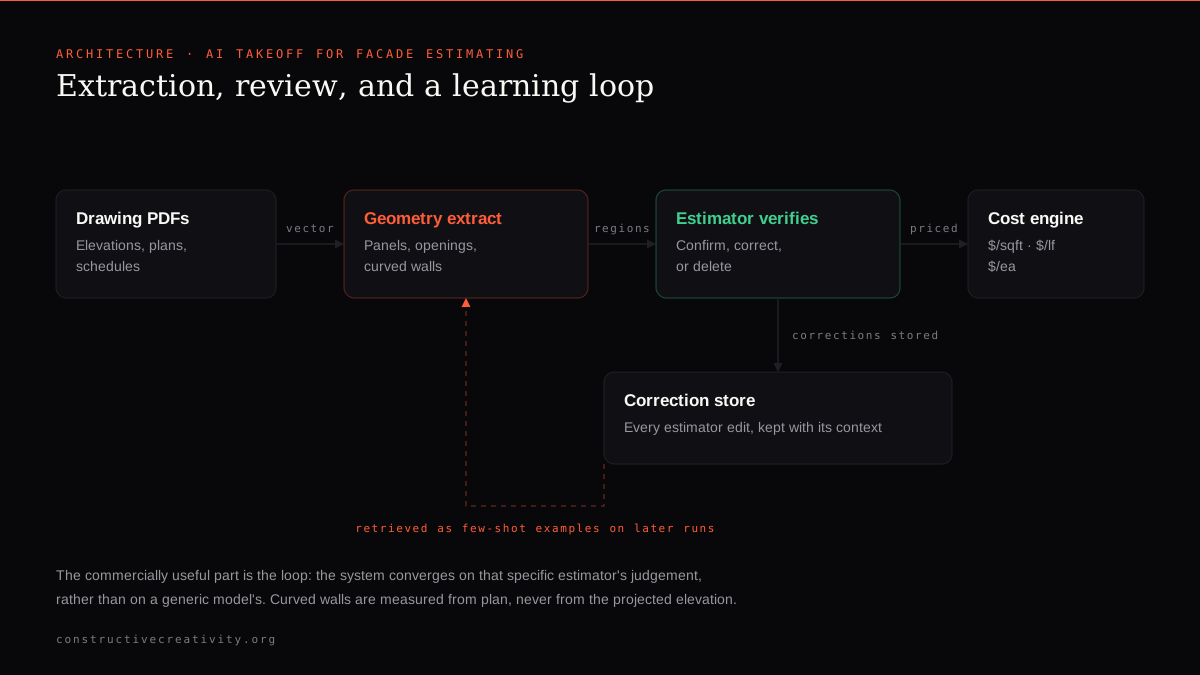
The takeoff itself is AI-assisted extraction from construction documents, plus a scope brief that reads across sheets. The part that matters commercially is the learning loop: every correction an estimator makes is stored and retrieved as a few-shot example on later runs, so the system converges on that specific estimator’s judgement instead of a generic model’s.

  • Next.js
  • Supabase
  • Claude
  • pdf.js
  • Bluebeam round-trip
Architecture: drawing extraction, estimator verification, and the correction learning loop
03 In development

SiteLedger

Construction finance · Zambia

Upload the Excel your accountant already keeps. Get live project dashboards and an AI you can ask whether a job is still making money.

What the AI does

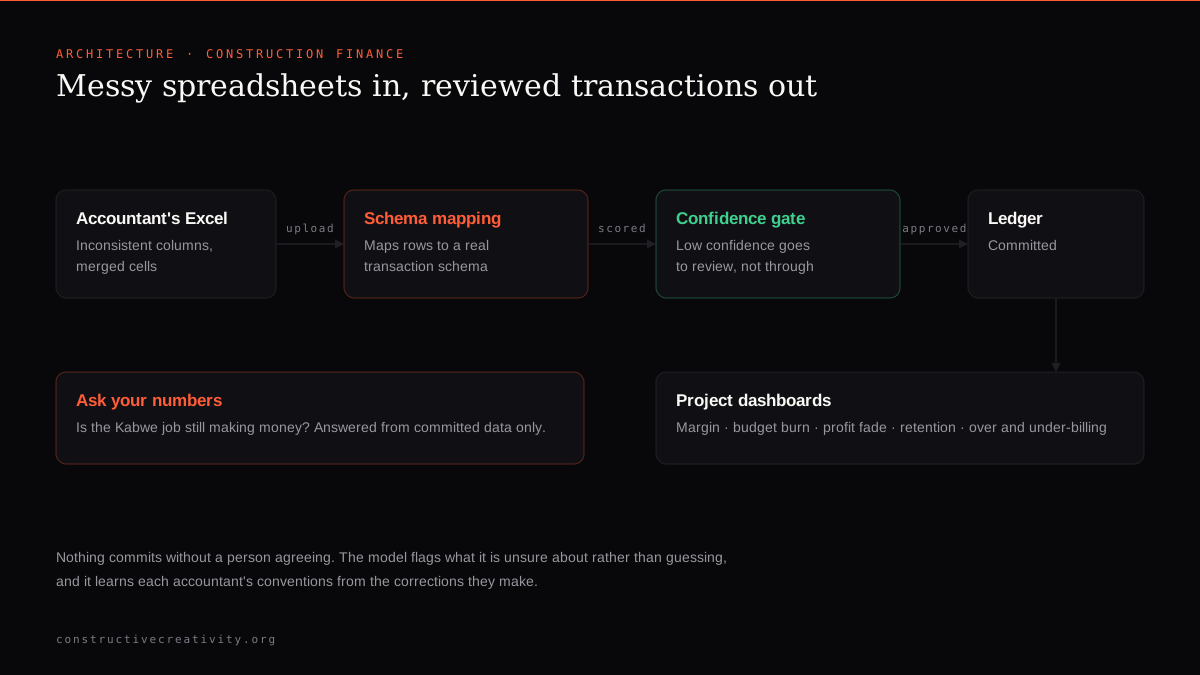
Claude maps messy, inconsistent spreadsheets onto a real transaction schema, flags rows it is not confident about rather than guessing, and learns each accountant’s conventions from the corrections they make. Then it answers plain questions about the numbers, such as whether a particular site is still profitable.

  • Next.js
  • Supabase
  • Claude
  • Excel ingestion
Architecture: spreadsheet ingestion, confidence gate, human review, and dashboards
04 Live

Guardia

Property maintenance · United States

A maintenance marketplace for multifamily buildings and HOAs where jobs are matched and auctioned on quality, not lowest price.

What the AI does

A delay-triage engine watches jobs against their SLA clocks, works out whether a job is actually at risk, and auto-reoffers it before the deadline is missed instead of after.

  • Next.js 14
  • Supabase
  • Claude
  • Stripe
Guardia maintenance marketplace interface

Why us

An engineering studio, not a reseller.

  • We ship, and you can check

    There is an app in the App Store with our work in it. There are businesses using these systems today. That is a different claim from a case study PDF.

  • You work with the people building it

    A small senior team, start to finish. No handoff to a delivery team you have not met, no account manager relaying questions.

  • You own everything

    Your repository, your infrastructure, your model accounts. Nothing here depends on us continuing to exist.

  • We will tell you not to build it

    If the honest answer is that a spreadsheet and one rule would fix it, that is what we will tell you. It is cheaper for us to be right than to be hired.

Questions

Common questions.

What does “AI integration” actually mean?

It means the AI goes into the systems you already run, rather than becoming another tool your team has to remember to open. In practice that is document intake, triage, cataloguing, monitoring, and assistants that can take an action rather than just answer a question.

We tried an AI pilot and it went nowhere. Why would this be different?

Most pilots fail on the boring parts: the model was confidently wrong and nobody caught it, or nobody could tell whether it was working. We design the confidence boundary and the evaluation set before we build the feature, so there is a real answer to “is this working” by week two.

How quickly can we see something real?

A scoped first workflow is typically live in two to four weeks. The call that decides what that workflow should be takes about thirty minutes of your time, and you then run it free for three months.

Do we need a data team or clean data first?

No. Every system on this page was built against messy real-world input: spreadsheets in inconsistent formats, PDF drawings, photographs of shelves. Handling the mess is the job.

Where are you based?

Beirut and the United States. We work with businesses across Lebanon, the Gulf, and the US, and most of the engagement runs remotely regardless of where you are.

Start here

Tell us what you want to build

A short note is enough. Tell us what your business does and what feels manual, and we will tell you what we would automate first, and roughly what it would cost.

We reply to every message. Usually within one working day.